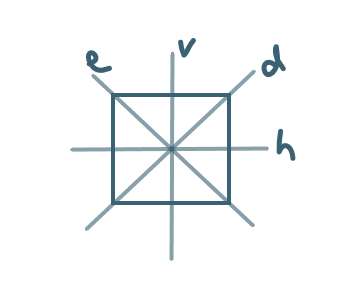
I will now introduce a family of groups related to the symmetries of polygons, namely Dihedral Groups. We will focus on the Dihedral group related to the symmetries of a square. Consider all the actions you can do to a square to put it back on its self. We can reflect the square along one of its axes of symmetry which we will denote by where is the axis of symmetry as shown in the following diagram;
Figure 1: Axes of Symmetry of a Square
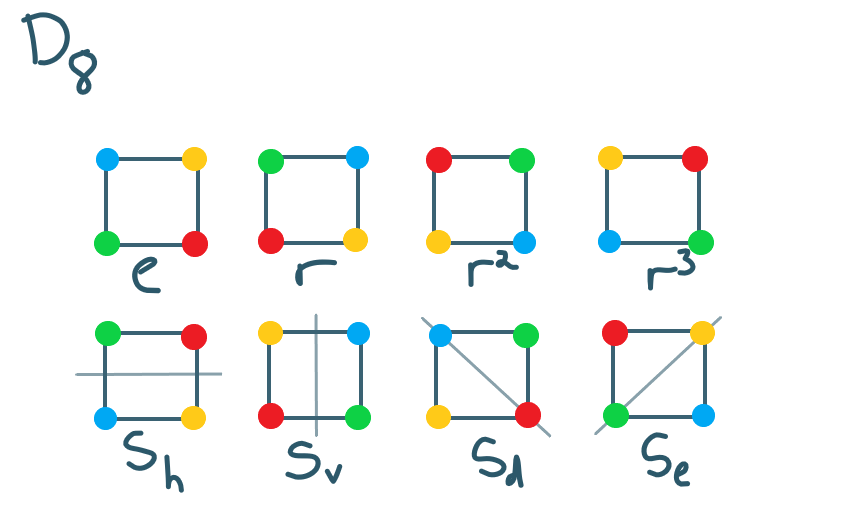
We can also rotate the square by multiples of 90 degrees. We let r denote a 90 degree clockwise rotation, denotes 2 of these rotations (i.e a 180 degree rotation) and denotes a 270 degree clockwise rotation (or equivalently a 90 degree anticlockwise rotation). Putting all of these elements together with the identity element (the action of nothing on the square) with the commutative binary operation of composition (applying the first one and then the second) forms the dihedral group denoted by , in the following diagram we allocate each corner a colour so that we can see how it moves with each of the elements. The dihedral groups are denoted by where n is the number of sides of the polygon the group is related to the symmetries of.
Figure 2: Visual representation of the Dihedral Group
We only go up to because . Take a second to convince yourself that it is closed under the composition law (composing two elements gives another element of the group), especially with respect to the reflections in the axes of symmetry.
Definition 2.1: Order of an element
Let G be a group and , the order of a is if there exists with . Otherwise .
Here means the smallest number that is greater than or equal to 1 such that .
In terms of the order of an element is more informally the number of times you can compose the element with itself to get the original square i.e. the identity element e.
In any group, the identity is the unique element of order 1.
Example 2.1: Let us examine the elements of , take a second to convince yourself of these result;
Definition 2.3: Subgroup
A subset H of a group G is a subgroup if:
H is closed under the composition law of G, , .
The identity element of G is in H, $e_{G}\in H$.
Every element of H has an inverse element of H, .
Definition 2.2: Cyclic
A group is a Cyclic if there exists an element a of G such that where . We say that “a generates G” or that a is “a generator of G”.
If is cyclic and is finite then , in otherwords the order of a cyclic group is the order of the element that generates it.
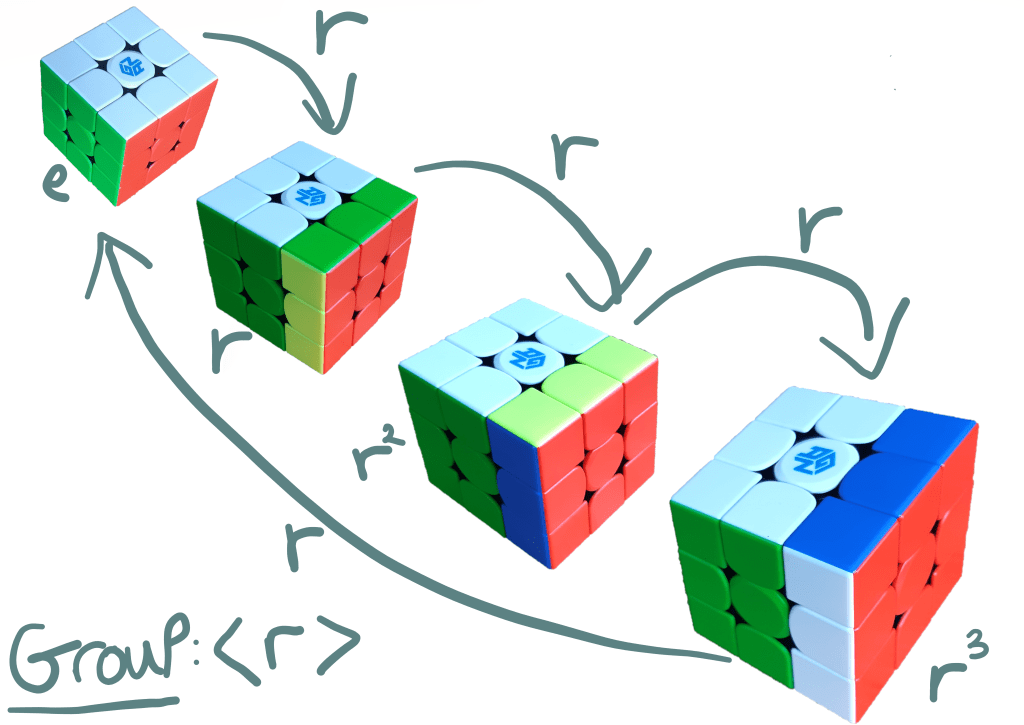
It is left as an exercise for the reader to check that is a cyclic subgroup of . A great way to visualise <r> is by isolating a side of the rubiks cube.






,
.
.



 Omar's Maths Notes