Groups are algebraic objects, and it is the study of these objects that forms a central part of abstract algebra, Group Theory. Before we get into our definition of a group, I will first introduce a few definitions that we will use to ultimately define a group.
Before we begin, you will need to remember that the symbol; 


Definition 1.1: Sets, Elements, Non-Empty and the Empty Set
A Set is a collection of objects. The objects that make up a set are called the Elements of the set. A set is Non-Empty if it has one or more elements. The Empty Set denoted 
Example 1.1: 
Definition 1.2: Cardinality
The Cardinality or size of a finite set A is the number of elements in the set A, denoted |a|. (we will look at the cardinality of infinite sets such as the Integers in future posts).
Example 1.2: For
Definition 1.3: Subset
Let A and B be sets. A is a Subset of B if every element of A is an element of B. This is denoted by A 
Example 1.3: The set 
Definition 1.4: Composition Law
A Composition law (or Binary Function) on a set A is a rule 


Example 1.4: Addition, +, on the set of all Integers,
Definition 1.5: Associative
A composition law

Example 1.5: Addition on the set of all integers is Associative. e.g. (1+2)+3=3+3=6=1+5=1+(2+3)
We can write this more generally as follows: 

Definition 1.6: Commutative
A composition law 
Example 1.6: Addition on the Integers is Commutative. e.g 1+2=3=2+1.
More generally; 

Definition 1.7: Group
A pair 
- (
) is associative:
.
- (
such that
- Every element of G has an inverse element in G:
such that


Example 1.7: The Integers,
More generally; 
Example 1.8: Every element of the Integers has an inverse element in the Integers with respect to the composition law of addition. e.g. 4+(-4)=(-4)+4=0.
More generally; 

Now if we take a step back and look at examples 1.4, 1.5, 1.6, 1.7 and 1.8 all together we can see that the Integers endowed with Addition forms a group, which we denote by 
Definition 1.8: Abelian
A Group is Abelian if its composition law is commutative.
Indeed the Integers endowed with Addition forms an Abelian Group.
Properties: Group
- The neutral element,
, is unique.
- The inverse of an element is unique.
.
.
- Cancellation laws:
and
.
and
.
For any element a of a group we can form a subgroup 
Definition 1.9: Order of a Group
The Order of a group G is the cardinality of the set, denoted |G|.
 where
where  is the axis of symmetry as shown in the following diagram;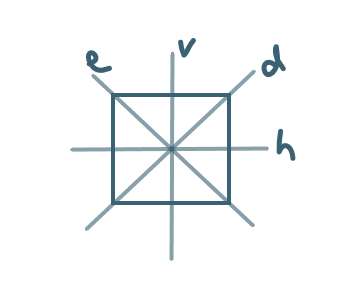
 denotes 2 of these rotations (i.e a 180 degree rotation) and
  denotes a 270 degree clockwise rotation (or equivalently a 90 degree anticlockwise rotation). Putting all of these elements together with the identity element (the action of nothing on the square) with the commutative binary operation of composition (applying the first one and then the second) forms the dihedral group denoted by
  , in the following diagram we allocate each corner a colour so that we can see how it moves with each of the elements. The dihedral groups are denoted by
  where n is the number of sides of the polygon the group is related to the symmetries of.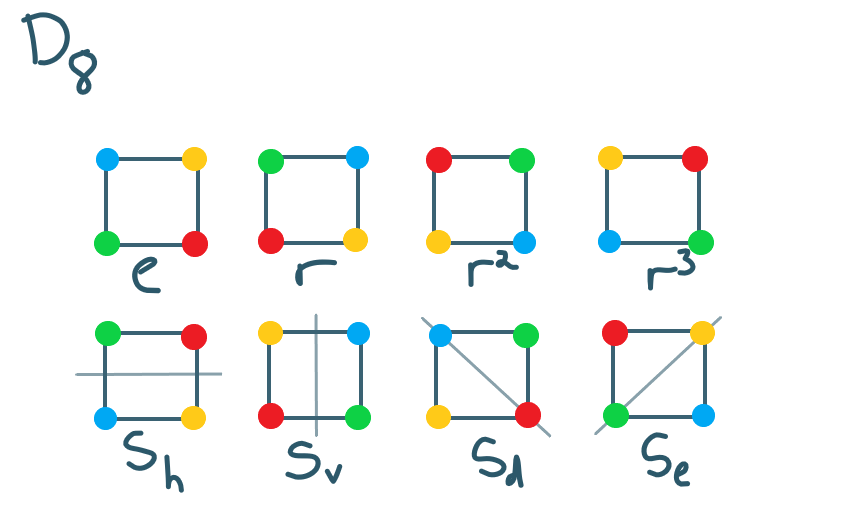

 . Take a second to convince yourself that it is closed under the composition law (composing two elements gives another element of the group), especially with respect to the reflections in the axes of symmetry.
 , the order of a is
  if there exists
  with
with  . Otherwise
  .
.


 .
. .
. where
where  . We say that “a generates G” or that a is “a generator of G”.
 is finite then
  , in otherwords the order of a cyclic group is the order of the element that generates it.
 is a cyclic subgroup of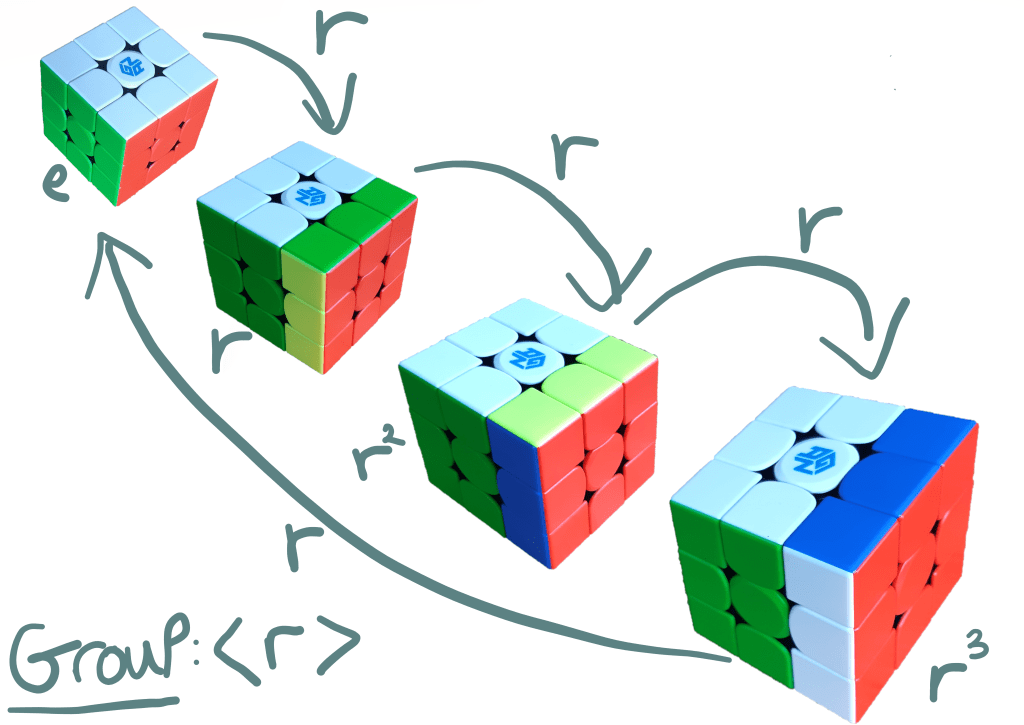
 Omar's Maths Notes